Pinout
Tip
Click the blue title to jump to the corresponding document.
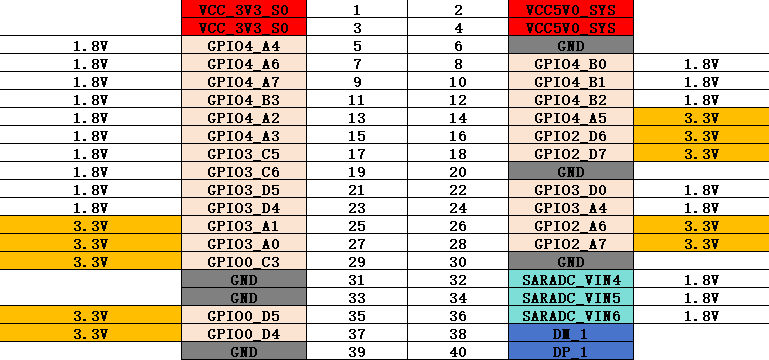
K7 Pinout
K7 is equipped with 40-pin GPIO header.

Pin Voltage
K7C Pinout
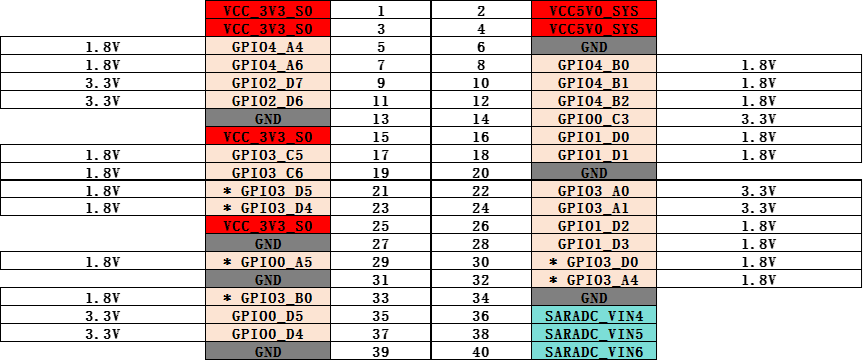
K7C is equipped with 40-pin GPIO header.

Pin Voltage
GPIO
- K7C expansion pins can support up to 23 GPIO channels.
- K7 expansion pins can support up to 22 GPIO channels.
CAN
- Both K7C and K7 expansion pins can be configured with up to 1 CAN channel.
PWM
- Both K7C and K7 expansion pins can support up to 7 PWM channels.
UART
- K7C expansion pins can support up to 4 UART channels.
- K7 expansion pins can support up to 5 UART channels.
SPI
- Both K7C and K7 expansion pins can support up to 1 SPI channel.
ADC
- Both K7C and K7 expansion pins are equipped with 3 ADC channels.
Q&A
- What is the difference between different voltage levels, and why can't communication work?
Reason: Voltage level standards do not match.
- Logic levels for 1.8V UART:
- High level (logic 1): Typically requires output ≥ 1.35V (according to LVCMOS/LVTTL standards).
-
Low level (logic 0): Typically requires output ≤ 0.45V.
-
Logic levels for 3.3V UART:
- High level (logic 1): Requires input ≥ 2.0V to be recognized as a valid high level.
- Low level (logic 0): Requires input ≤ 0.8V to be recognized as a valid low level.
Solution: To achieve communication between 1.8V and 3.3V UART, a level conversion circuit must be used for adaptation. It is recommended to use a bidirectional level shifter.
- Example ICs: TXB0108, TXS0108E, 74LVC1T45, etc.
- Principle:
- The 1.8V side and the 3.3V side are powered separately (e.g., 1.8V and 3.3V).
- The chip automatically adjusts the output level based on the supply voltage to ensure signal compatibility.